GEO vs SEO vs AEO: What's the Difference?
Three acronyms, endless confusion. SEO, AEO and GEO are not competing strategies, they are three layers of the same goal: being found. Here is what each one means, how they differ, and the order to tackle them in.
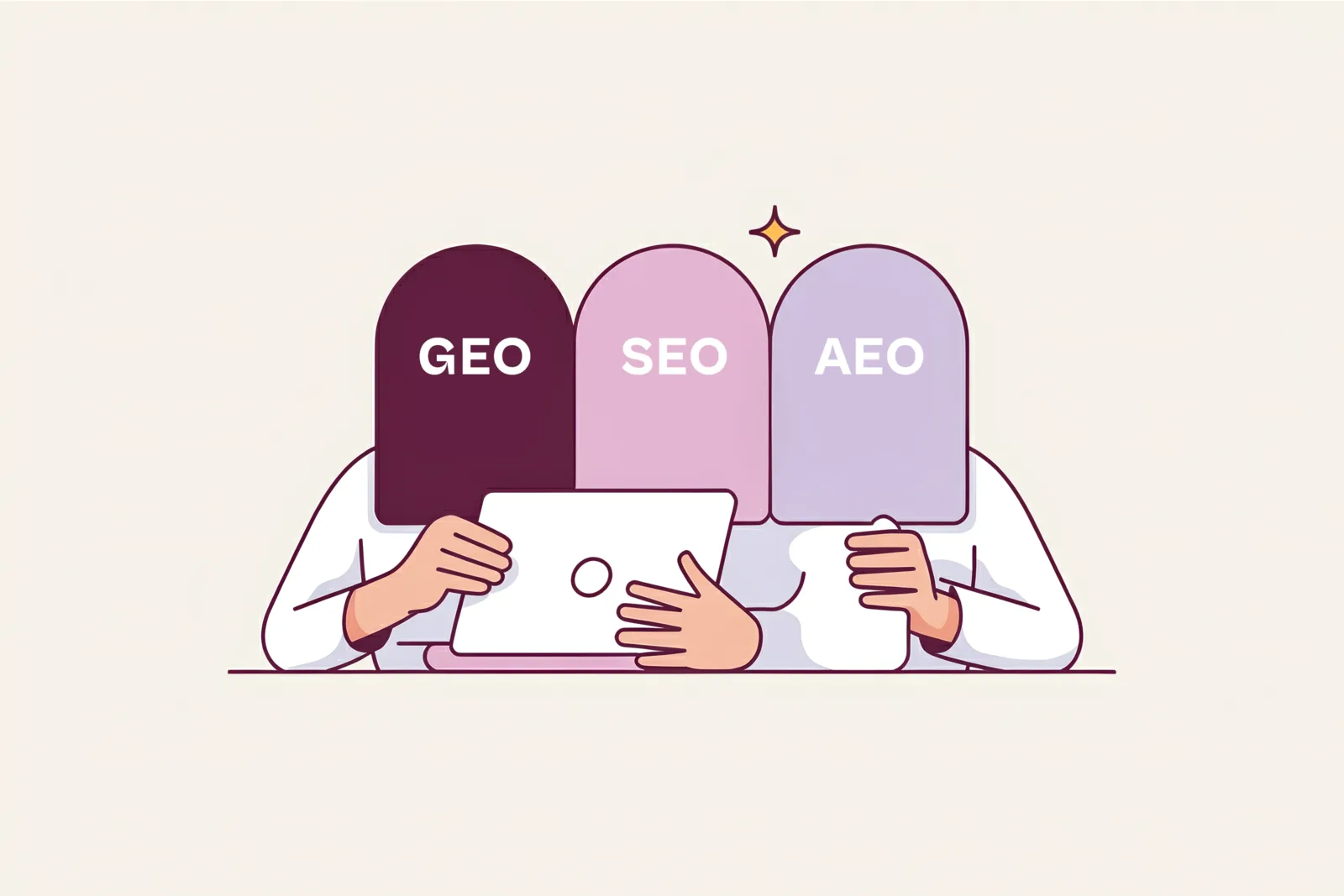
Quick answer
SEO gets you ranked in the list of links. AEO gets you featured as the direct answer. GEO gets you cited inside AI-generated answers.
SEO wins the click, AEO wins the answer, GEO wins the citation. They share a foundation, so the smart move is to sequence them, not pick one.
The three at a glance
Each targets a different destination and a different moment in how people search. This is the whole comparison in one table.
| SEO | AEO | GEO | |
|---|---|---|---|
| Stands for | Search Engine Optimization | Answer Engine Optimization | Generative Engine Optimization |
| Goal | Rank in the results | Be the direct answer | Be cited by AI |
| Shows up in | Google, Bing | Snippets, voice assistants | ChatGPT, Perplexity, AI Overviews |
| Measured by | Ranking, clicks | Snippet wins, zero-click | Citations, brand mentions |
SEO vs AEO
SEO and AEO both live inside traditional search engines, which is why people mix them up. The difference is what they are aiming for. SEO wants your page to rank in the list, so someone clicks through. AEO wants your content to be the answer the engine pulls out and shows on its own, often with no click at all.
In practice they reinforce each other. You still need to rank to be considered for the answer box, and answer-first content tends to rank well. The distinction matters most in how you write: SEO thinks in pages, AEO thinks in questions and answers. For the deep dive, read What is SEO and What is AEO.
AEO vs GEO
AEO and GEO are close cousins. Both reward content that leads with a clear, direct answer, and both care about structure and freshness. The difference is where the answer appears. AEO targets the answer box and voice results inside a search engine. GEO targets the citation inside an AI tool's generated response, where the model writes an answer and names its sources.
This is why the terms "AEO and GEO" often get used together: the work overlaps so much that improving one usually lifts the other. The gap is that GEO also depends on signals a search engine does not use, like being mentioned across credible third-party sites, which is what teaches an AI model to trust and name you. For more, read What is GEO.
GEO vs SEO
This is the widest gap of the three. SEO and GEO can feel unrelated because they run on different systems. A page that ranks well on Google can be completely absent from ChatGPT, and roughly 80% of the URLs ChatGPT cites do not appear in Google's top 100 results. Optimizing for one does not win you the other.
SEO is mature and competitive. GEO is early, which is exactly why it is worth attention now: the businesses building these signals today are the ones AI will name when the rest of the market catches up.
How they work together
Here is the part that resolves the confusion. You do not pick one. The same core habits feed all three: content that answers a real question, a fast and crawlable site, clear structure, and genuine authority from other sites. Build that foundation and you rank on Google, win the answer box, and get cited by AI from the same body of work.
The sensible order is to sequence them. Get SEO solid first, because a crawlable, authoritative site underpins everything. Layer AEO so you win direct answers and voice results. Then add GEO to get named inside AI tools, where the competition is thinnest.
Which should you prioritize?
If your site is weak on the basics, start with SEO. If you rank but keep losing the answer box, focus on AEO. If your buyers are already asking ChatGPT for recommendations and you are nowhere in the answers, GEO is your fastest gain. Most businesses need all three eventually, and the only way to know where your gap is right now is to measure it.
Find your gap across all three.
The free AI Visibility Snapshot shows where your business appears across ChatGPT, Gemini and Perplexity, and what to fix first.
Frequently asked questions
What is the difference between GEO, SEO and AEO?
SEO (Search Engine Optimization) gets your page ranked in the list of links on Google and Bing. AEO (Answer Engine Optimization) gets your content featured as the single direct answer, in a snippet or a voice result. GEO (Generative Engine Optimization) gets your business cited inside the answers generated by AI tools like ChatGPT and Perplexity. SEO wins the click, AEO wins the answer, GEO wins the citation.
What is the difference between SEO and AEO?
SEO optimizes to rank in the list of search results, measured by position and clicks. AEO optimizes to be the one answer a search engine or assistant features or reads out, measured by featured snippets and zero-click answers. The content techniques overlap heavily, but AEO formats content so a machine can lift a clean answer, while SEO focuses on ranking the whole page.
What is the difference between AEO and GEO?
AEO targets structured answer positions inside search engines and voice assistants, like Google featured snippets. GEO targets citations inside the generated responses of large language models such as ChatGPT and Perplexity. AEO and GEO are close cousins, because both reward a clear, answer-first structure, but they show up in different places: the answer box versus the AI response.
What are AEO and GEO in simple terms?
AEO and GEO are the two newer layers of search visibility. AEO (answer engine optimization) is about being the direct answer a search engine gives. GEO (generative engine optimization) is about being named inside an AI tool’s written answer. Together with traditional SEO, they cover the three ways people now find businesses: ranked links, direct answers, and AI recommendations.
Should I focus on SEO, AEO or GEO?
Do not choose one, sequence them. Start with SEO because a crawlable, authoritative site is the foundation for everything. Layer AEO to win direct answers and voice results. Add GEO to get cited by AI tools, where most competitors have not started yet. The same core habits, clear structure, direct answers and real authority, feed all three, so the foundation is shared.
Go deeper on each
About the author
Rose Butcher
Rose is an AI Visibility Specialist who helps PR and digital marketing agencies add AI search visibility to what they offer their clients, from a free snapshot to done-for-you implementation. Based in the UK, working worldwide.
Connect on LinkedIn →